
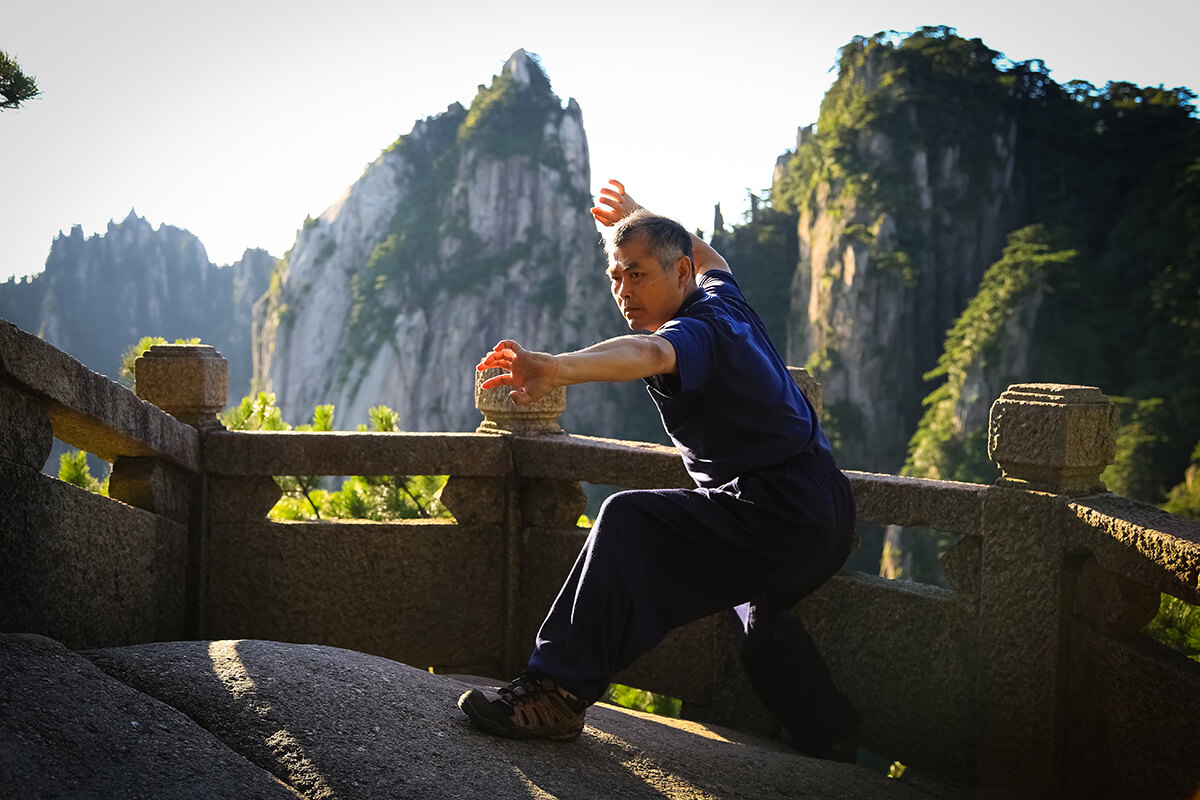
“The most important thing in Qi practice is to achieve an effect. But first the qìgǎn needs to be cultivated. First the seed must be planted, and then slowly nurtured.” — Master Chen
Context and Perspective
The concept of qi remains difficult to convey outside the cultures and lineages in which its vocabulary developed. In martial practice, it is best approached not as a single object to be defined, but as part of a connected method involving breath, posture, awareness, intention and movement.
Qi is deeply rooted in Chinese philosophy, medicine and martial culture, and no single English word fully captures its range of meanings. Depending on context, 氣 may refer to breath, air, vitality, disposition or the functional quality experienced through practice. In this article, qi refers primarily to the traditional martial experience cultivated through coordinated body, breath and intention.
Attempting to isolate qi from posture, breathing, intention and movement can obscure how it is used in practice. The descriptions that follow should therefore be understood as training instructions and lineage-based experience rather than as a universal definition applying to every Chinese martial tradition.
In the following pages, I aim to offer insights and approaches acquired through the guidance of esteemed mentors such as Chen Lǎoshī, Marco Shīfù, James and the fellow practitioners with whom I have had the privilege of training, as well as through my own research and experience.
Before discussing qìgǎn, we should establish how the terms are being used here. A simple working explanation that serves the purpose of this article is as follows:
Qi (氣): A broad traditional concept with meanings that include breath, air and vitality. In this method, it refers to the functional and experiential quality cultivated through the integration of body, breath and intention.
Gǎn (感): Sensation, feeling or perception. In 氣感 (qìgǎn), it refers to the practitioner’s awareness of sensations traditionally associated with the movement and cultivation of qi.
With these concepts in mind, we can begin to discuss the prerequisites and preparation for cultivating qìgǎn.
Prerequisites and Preparation
Before one can meaningfully cultivate qìgǎn, a stable connection with the lower dāntián is required. In this method, the practitioner follows the location and manner of attention taught by the instructor; other traditions may describe the dāntián as a point, centre or region within the lower abdomen.
Sustained awareness of the dāntián gives intention (意, yì) a centre from which the breath, posture and movement can be organised.
Another crucial aspect is posture. The body should assume an alignment that minimises unnecessary muscular tension while maintaining structural integrity. Imagine the spine lengthening as if suspended from the crown, the chest gently contained, the shoulders released and the joints open.
Although this sounds straightforward, the quality of fàngsōng (放鬆)—release without collapse—requires careful and persistent practice.
Breath and Breathing
“The breathing of the true person comes from the heels, while ordinary people breathe from the throat.” — Zhuangzi
The character 氣 includes meanings connected with air and breath, reminding us of the important role breathing plays in cultivation.
Zhuangzi’s image of breathing from the heels should not be read merely as an instruction to take a large breath. It evokes breathing that is deep, rooted, quiet and integrated throughout the body.
In this practice, the breath is cultivated through four qualities:
Deep: The breath settles naturally towards the lower abdomen as the body releases. Depth should arise through relaxation rather than by forcing the largest possible inhalation.
Fine: Visualise the breath as a delicate golden thread settling towards the dāntián. It should become subtle, quiet and smooth, without strain.
Long: As relaxation improves, inhalation and exhalation gradually lengthen. They should remain comfortable; exact equality is less important than continuity and ease.
Unbroken: The breath should flow without abrupt catching, holding or forcing. Its rhythm and volume remain even enough that movement and intention can accompany it without disturbance.
Together, these qualities help settle the mind, release unnecessary tension and coordinate the breath with the body. They should emerge gradually and should never be imposed through strain.
Harmonising Movement
“Flow with whatever may happen and let your mind be free. Stay centred by accepting whatever you are doing. This is the ultimate.” — Zhuangzi, in a modern English rendering
In this section, I will use Master Chen’s qigong as a familiar reference point. The content that follows is shaped by the instruction I received in this method of qigong, combined with my own investigations and experimentation with ideas drawn from a range of influences.
For clarity, the practice can be described in three interconnected stages. These are not absolute divisions, but training emphases that progressively make the relationship between intention, qi sensation and physical movement more distinct—and then more unified.
Qìgǎn alone is not yet martial skill. Considerable work is required to integrate intention, qi, structure and trained force (勁, jìn) so that they can be expressed through the fist.
As Master Chen stated, the seed must first be planted and then nurtured.
Basic Movements
Advancing in qigong requires the harmonious alignment of movement, breath and intention. Merely performing the exercises mechanically is insufficient.
In the initial body-breathing exercise, awareness remains connected to the dāntián while attention also extends to the palms. The hands should remain part of one coherent structure. As they move outwards, the practitioner opens the joints, contains the chest and avoids separating the arms from the body.
The exercise cultivates a sensation of expansion beginning with the inhalation and continuing through the upward and outward movement of the hands. The practitioner does not simply enlarge the physical shape, but allows awareness to extend beyond the habitual boundary of the body.
At the fullest point, the expansion is gently gathered back towards the dāntián. This is an exercise in coordinated intention, sensation and movement—not an attempt to force qi through muscular effort.
As the movement becomes familiar, greater attention can be given to breathing that is deep, fine, long and unbroken. These qualities should remain natural and unforced. If the breath becomes coarse, tense or uncomfortable, the practitioner should reduce the effort and return to relaxation and alignment.
With consistent practice, the practitioner may experience warmth, tingling, fullness, pressure or a subtle sense of connection in the palms. Within traditional training, such sensations are commonly recognised as early qìgǎn.
These signs should be observed and nurtured without chasing or exaggerating them. The aim is eventually to integrate this awareness with structure, timing and jìn rather than to collect sensations for their own sake.
The Body Moves; Qi Sensation Follows
In the first stage, the practitioner uses intention to observe how qìgǎn accompanies physical movement. The body provides a clear pathway and the sensation follows it, like a shadow following an object.
The mind is already active here: it maintains awareness of the dāntián, the whole-body connection and the path of movement.
Using the basic movement described above, the hand—or another part of the connected body—initially leads while the qi sensation is perceived as following slightly behind. This apparent delay is a temporary method for making the relationship easier to recognise; it is not the final method of issuing power.
Arthur’s analogy that “the arm or fist is just the transport layer” usefully reminds us that the limb should not act in isolation.
In martial application, however, qi should not be confused with the complete expression of force. Intention (意, yì) directs; qi supports and mobilises; and trained force (勁, jìn) is expressed through rooted, aligned and coordinated movement.
The goal is for intention, qi, structure and jìn to become integrated so completely that no perceptible delay remains.
Intention and Qi Initiate the Movement
The next stage reverses the practitioner’s emphasis.
Building upon the body-breathing exercise, awareness is placed in the palms and extended through the forearms while remaining connected to the dāntián. Intention first establishes the direction, qìgǎn begins to move and the physical body follows without local muscular forcing.
The classical relationship may be summarised as:
Yì leads qi, and qi leads the movement.
This approach can also be explored in 三度橋手. In the opening phase, intention and qìgǎn rise into the arc and the connected body follows. In the downward phase, the change begins internally before appearing externally.
With partner practice, awareness extends through the bridge and into the point of contact. By attending to changes in pressure, direction, tension and intention, the practitioner develops 聽勁 (tīng jìn), or “listening to jìn.”
Before contact, posture, rhythm, distance and preparatory movement may reveal the opponent’s intention. Tīng jìn, however, is most precisely cultivated through tactile connection rather than through an assumed ability to detect an invisible energy field.
Mind Unifies Intention, Qi, Body and Jìn
The final objective is to cease treating the practitioner and opponent as two unrelated bodies.
Through bridge contact, awareness extends into the opponent’s structure so that changes in pressure, balance, direction and intention are felt as part of one connected system. This produces the following and sticking quality particularly evident in Snake Fist practice.
By neither resisting nor disconnecting, the practitioner can understand the opponent’s movement, preserve contact and influence the opponent’s centre.
All three stages depend upon the mind’s active engagement.
At first, intention observes qi sensation following a clearly organised movement. Next, intention and qi initiate movement. Finally, intention, qi, body and jìn function as one, without an artificial separation between them.
This is not a one-time linear method, but an ongoing process of revisiting, testing and refining the fundamentals.