
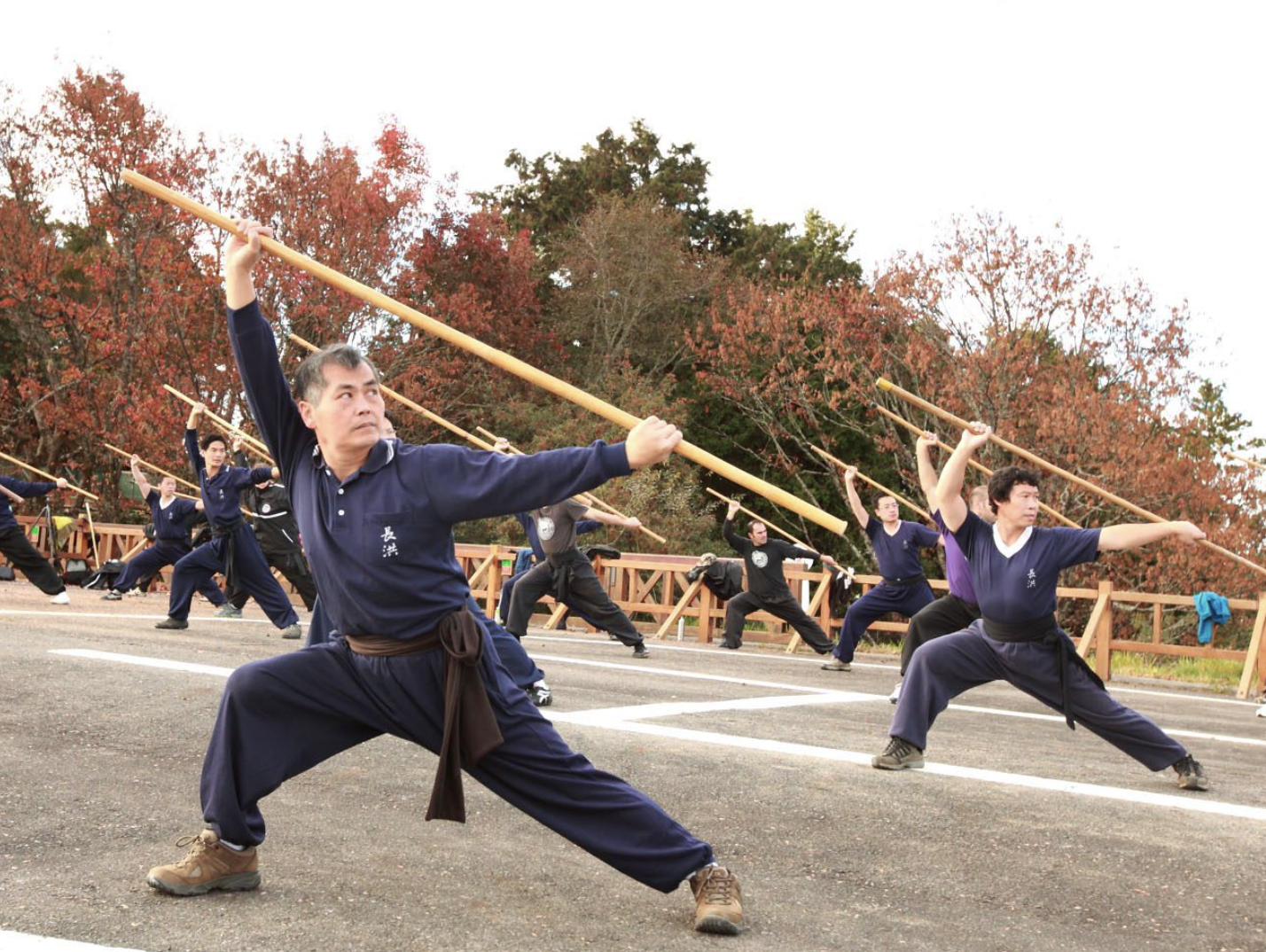
How you train matters. A clear method helps you make the most of your practice time, build on corrections and catch mistakes before they become habits. Give your basics consistent attention, slow down enough to feel what is happening, and work methodically through your forms. This gives you a better chance of making steady progress while limiting the errors you carry into the next session.
This is a solo practice routine to follow outside of class, at least three times a week. Use this time to work through what your coach has taught you and integrate the corrections you have been given. Bring those corrections into each session and repeat them carefully until they become part of how you move.
Give yourself forty minutes for basics, qigong and stance work, followed by an hour or so on one form. Allow enough time to pay attention, make corrections and repeat the movements properly.
Basics and Stances
Start with these six basic exercises. Work carefully, paying attention to posture, balance and how your body connects through each movement.
Six basic exercises
- Huó Bì (活臂): Loosening the arms.
- Shuǎi Yāo (甩腰): Swinging the waist.
- Huó Yāo (活腰): Loosening the waist.
- Qiē Zhǎng (切掌): Cutting palms.
- Tuō Tiān Huà Dì (托天畫地): Supporting heaven, drawing the earth.
- Xià Dūn (下蹲): Squatting down.
Practise Mǎ Bù (馬步), horse stance; Gōng Bù (弓步), bow stance; and Zuò Pán (坐盤), seated stance, including the changes between them. Hold each stance for one minute before changing, and continue this practice for at least ten minutes.
Maintain your structure throughout the hold, then move deliberately into the next stance. When changing from Mǎ Bù to Gōng Bù, use the correct heel-toe, toe-heel shifting, rotating around your vertical central axis. Control your weight through the transition and avoid swaying from side to side.
Pay attention to where force is leaking. Look for the places where your structure or movement stops adhering to the central axis. Notice whether you lean, sway, lift a shoulder or allow part of your body to pull away from the rotation. Slow the transition down and correct the point where that connection is lost.
If your posture collapses, adjust your height and establish the stance properly.
Qigong
Focus on relaxation and allow the qi to sink down to the dantian. Give your ribs and torso time to soften and melt inward, releasing the tension that holds your chest up.
As the qi sinks, feel an expansion upward, like a telescopic aerial extending. Keep that image in mind: lengthening upward as the ribs and torso settle inward. Avoid inflating your chest or pushing your ribs outward like a balloon.
Let this feeling develop through relaxation. Forcing yourself taller or holding your chest in position introduces more tension.
Tiger Breathing: Sān Dù Qiáo Shǒu
Practise tiger breathing, 三度橋手 (Sān Dù Qiáo Shǒu), literally “Three Times Bridge Hands.”
This practice uses 逆式呼吸法 (Nì Shì Hū Xī Fǎ), the reverse breathing method, as taught in class.
Keep the breathing continuous and unbroken.
Keep your intent at the dantian.
Use the body to regulate the qi.
Develop smooth breathing and coordinated movement before adding power and speed.
Inhale as the hands draw back towards the sides of the chest, then exhale as the hands extend forward, sinking the force and directing qi towards the fingertips. The exhalation is slow and controlled through the mouth, with a quiet hiss and a heavier feeling towards the end.
Settle into Sì Píng Dà Mǎ (四平大馬), the Four-Level Wide Horse Stance.
Place your feet wide apart, parallel and pointing straight forward, with both soles flat on the ground. Sit down between your legs until your thighs are level, keeping your knees directly above your ankles and your lower legs vertical. Think of a box: your thighs form the top and your shins form the sides.
Keep your weight evenly distributed and your torso upright over the centre of your stance. Avoid leaning forward or arching your lower back.
In “I” Shape Taming Tiger Fist, Master Chen Qing He gives three groups of requirements for this stance:
Four-Level Wide Horse Stance requirements
- Four level: Head, shoulders, thighs and heart.
- Four upright: Head, body, posture and qi.
- Four sinking: Shoulders, elbows, hips and qi.
Use these requirements to examine your posture throughout the practice. Keep your head and shoulders level, your body upright, and allow your shoulders, elbows and hips to settle as the qi sinks towards the dantian.
Complete three sets of twelve breaths, using the method taught in class. Maintain the feeling of upward lengthening as your ribs and torso soften inward.
You can substitute snake basics or crane basics for this part of the session. Complete fifty repetitions of whichever you choose.
Spend an Hour on One Form
Choose one form and give it an hour or so of careful work. Break it into sections, examine the movements and repeat the parts that need attention.
Do not rush through it. Practise deliberately and methodically. Find a rhythm that works with the movements, allowing each change in direction, weight and intention to happen properly.
Work on maintaining a stable dantian throughout. Notice what happens to your centre when you step, turn, sink or change stance. Pay particular attention to the transitions and whether you remain connected through them.
Speed does not give you power at this stage. Until you can apply the correct feeling, moving quickly is detrimental: it carries you past the places you need to examine and reinforces mistakes through repetition.
Give yourself time to develop the structure, connection and feeling. Practise at a pace where you can maintain them.
Pay Attention to the Feeling
If you feel stiff and locked up, the movement is almost certainly wrong.
Slow down and examine where that stiffness begins. Check whether you are lifting your shoulders, bracing your chest, forcing the movement with your arms or losing your centre as you turn.
Maintain your structure while releasing unnecessary tension. Repeat the section and notice how the movement changes.
Take the corrections from class into your own practice. Work on them patiently and carry them through the form. When something remains unclear, take it back to your coach at the next class.